 Sickle
Give your agent your inbox.
All of them.
Sickle connects every mailbox you own — Gmail, Outlook, iCloud, Fastmail, Yahoo, your company’s IMAP server — and hands them to Claude, Codex, Cursor or OpenClaw over MCP.
Works with any MCP client on macOS, Windows or Linux — nothing to install.
Remote. Nothing to install.
Point your agent at a URL, approve the OAuth prompt, done. No binary, no local process, no credentials pasted into a config file.
Go to Settings → Connectors, open the Add menu and choose Add custom connector, then paste the server URL. The same steps work in Claude on the web.
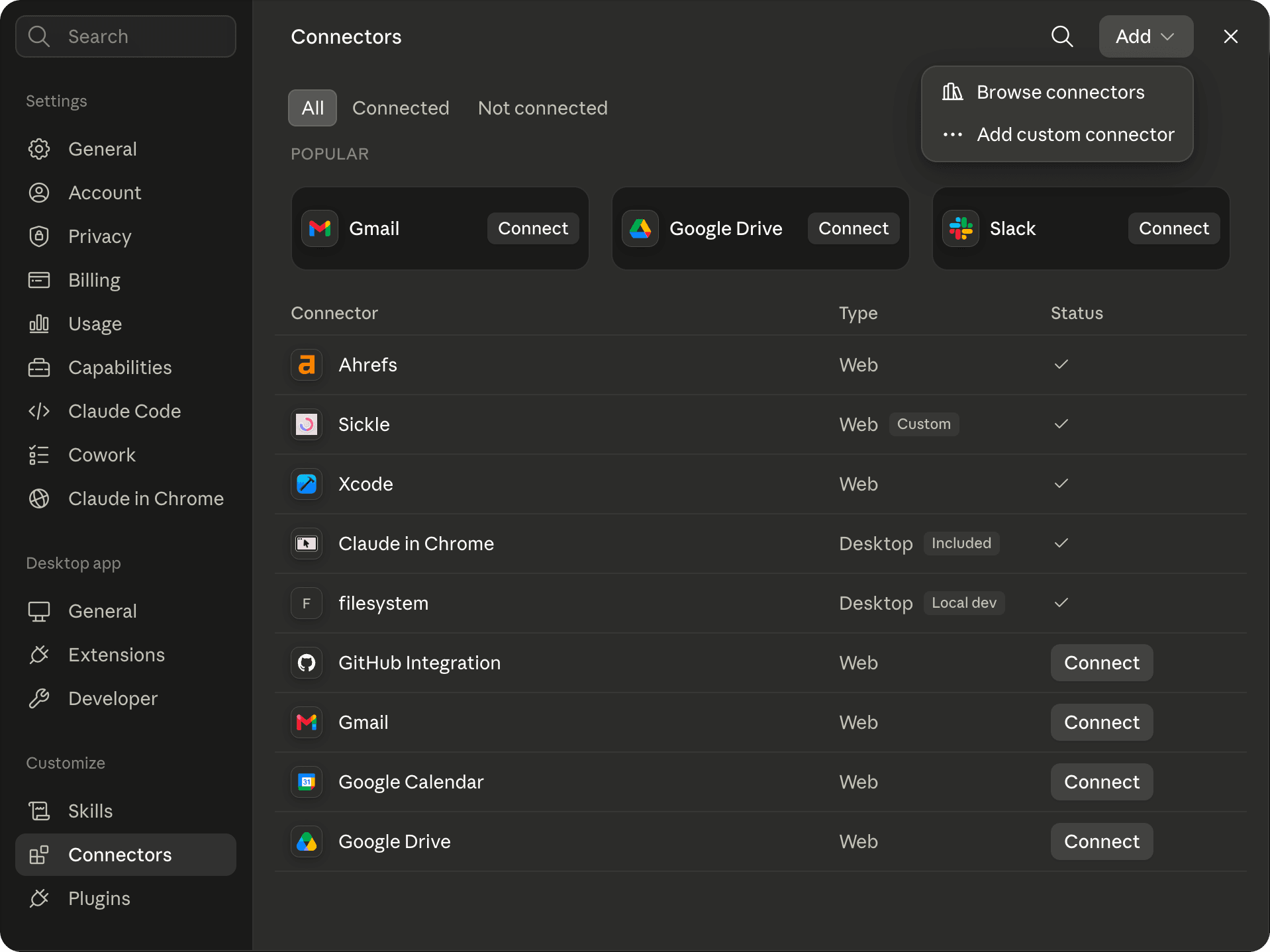
Whichever client you use, it opens a Sickle sign-in page and asks you to approve the access it wants. There are no API keys to copy across, and your assistant never receives your mailbox password — only a token you can revoke at any time.
You work the inbox. So does your agent.
Same accounts, same folders. When it archives something it is gone from your mail app, because there is only one mailbox.
 sickleread · change
Ask anything, or type / for commands
Every mailbox you own. Including the awkward one.
Gmail and Outlook over OAuth. Everything else with a host, a port and a password. No cap on accounts.
Your agent sees a slice of your mail and thinks it’s all of it.
Fastmail, iCloud, the company server — nothing.
It can tell you about the newsletter. It can’t archive it.
Most email connectors authenticate a single Gmail account. Sickle connects as many mailboxes as you have and hands your agent all of them at once — every provider with an IMAP port, read and change.
 GmailOAuth
 Outlook / 365OAuth
 iCloudapp password
 Fastmailapp password
 Yahooapp password
 Any IMAP hostmanual
Your agent, working your mail.
One job per card, with the tools it calls. Hover one to watch it happen.
One question, every account. Results come back with the mailbox they live in.
- LedgerlyworkInvoice LG-0314 · March2 Apr
- Hopper & VinepersonalYour March order receipt31 Mar
- Marta OyelaranworkRe: March invoice — brand refresh28 Mar
- Quillbury BookspersonalBook club · March invoice3 Mar
Not the preview — the conversation, and the line in it that matters.
Mark, move, archive. It works the same folders you do.
- Eleanor HughesRe: SOW v3
- Deskly14 notifications
- Hopper & VineWebinar: Omnichannel…
- Gradient Weekly37 links
Read, or read and change — granted per client.
Your agent wants to use your mail- Reademail_read
- Changeemail_change
- Sendemail_sendnot requested
Trash means your Trash folder. No tool deletes for good.
Disconnect a client and its access ends within the hour.
- CClaude Desktopread · changeDisconnect
- CCursoraccess endedDisconnected
- CCodexread · changeDisconnect
Email is untrusted input. Anyone can send you a message, and an assistant reading your mail will also read any instructions hidden inside it. Grant email_change only to clients you trust, and review what your assistant proposes before approving it.
How your mailboxes get there without the app.
The connector serves whatever mailboxes your Sickle account holds. You add them on the web, once, and every agent you connect sees all of them.
- 01Sign in at sickle.app.
The same account your agent will sign in to when you approve it.
- 02Open Mailboxes, choose Connect mailbox.
One dialog, one provider at a time.
- 03Pick the provider.
Gmail and Google Workspace, Outlook, Hotmail and Live sign in with OAuth in your browser. iCloud, Yahoo and Mail.ru take an app password. Anything else takes a host, a port and a password.
- 04Repeat for the second and the third.
There is no cap. An agent that is already connected sees the new mailbox the next time it calls list_accounts — nothing to reconnect.
It comes with a native Mac mail client.
Every mailbox in one window, a colour per account, an email cleaner and Vim keys. Same mailboxes. Whatever the agent archives is gone from the app, because there is only one inbox.
See the Mac appOne subscription. No Mac needed.
The connector is included in the same subscription as the Mac app — not a separate add-on — and it works from any OS.
See pricingAsked before you ask.
Which agents work?
Claude Desktop and Claude on the web, Claude Code, Codex, Cursor, OpenClaw — and any other client that can add a remote MCP server over HTTP.
Do I need the Mac app to use the connector?
No — the app is optional, and the connector works from any OS. Sign in at sickle.app and add your mailboxes there: Gmail, Outlook, iCloud, Yahoo or any IMAP server. The connector signs in with the same account, so your agent sees every mailbox you add, on the web or in the app.
Can it send email as me?
Not today — no tool sends mail, so an assistant cannot email anyone on your behalf. You may see an email_send permission on the approval screen; nothing uses it yet. It is granted separately from reading and changing, so if sending arrives it stays yours to allow or refuse.
Do you store my email?
Your agent never receives your mailbox password — only a token you can revoke. The connector reads from your mail server when your agent asks and passes the result on; it does not keep a copy of your mailbox.
My company runs its own mail server. Does it work?
Yes. Anything with an IMAP host, a port and a password.
More than one account?
As many as you have, in one window and through one agent connection. There is no cap on accounts.
How do I revoke an agent?
Sign in to sickle.app, open Connect AI, and disconnect it under Connected assistants. Access it already holds ends within the hour.
What if an email tries to give my agent instructions?
It might. Email is untrusted input, and an assistant reading your mail reads whatever is in it. That is why change is a separate scope, why nothing is irreversible, and why you should review what an assistant proposes before approving it.
Windows, Linux or iOS?
The connector is not tied to an OS — it runs on our server, so any agent that can add a remote MCP server can use it, wherever that agent runs. Only the mail app is macOS only.
Is the connector included in the subscription?
Yes. One subscription covers the Mac app and the agent connector; the connector is not a separate add-on.